
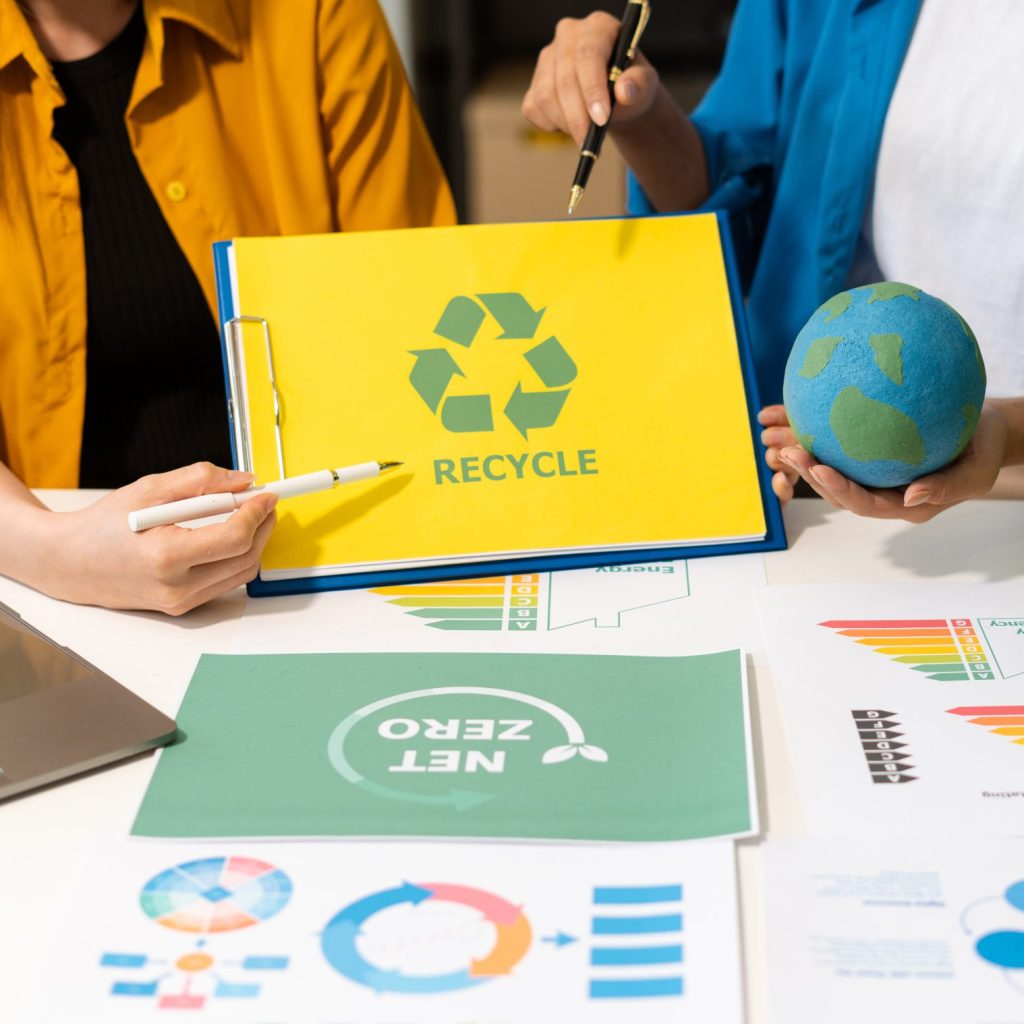
The UK is once again projected to miss its national recycling targets, according to updated data from DEFRA and WRAP. Municipal recycling rates have stagnated in the mid-40 per cent range for several years, far below the long-standing 65 per cent goal originally set for 2025. Waste-sector experts consistently attribute this underperformance to two key issues: contamination and consumer confusion. As both problems intensify, environmental labels are becoming a central tool in helping the public navigate disposal decisions — and in supporting the wider system’s ability to process packaging correctly.
Contamination remains the most damaging barrier. Materials recovery facilities (MRFs) report that a significant proportion of plastics, paper and metals arrive with items incorrectly placed in kerbside recycling. Compostable and biodegradable plastics represent a growing share of this problem. PLA cups, starch-based films and packaging labelled “biodegradable” or “eco-friendly” are commonly deposited in plastics recycling streams, where they interfere with rPET and rHDPE processing. Recycling operators have warned that such contamination can compromise entire bales, reducing the UK’s ability to meet recycled-content targets.
Inconsistent or unclear environmental labels are a major contributor. Many products use misleading graphics, non-standard recycling icons or unqualified claims such as “100% recyclable” without clarifying whether the material is accepted by local authorities. Consumers encounter contradictory instructions across packaging types, leading to uncertainty that often results in incorrect disposal.
The upcoming Simpler Recycling framework, scheduled to take effect from 2026, aims to address this confusion by enforcing uniform disposal instructions. Under the new system, all consumer packaging must display a clear, binary message: “Recycle” or “Do Not Recycle.” These labels must be prominent, consistent in language and backed by material-specific guidance. While the system should increase clarity, it also forces brands to revisit their environmental labels to ensure compliance and avoid misleading consumers.
pEPR (Packaging Extended Producer Responsibility) is adding further transparency obligations. Brands must offer clearer declarations of material content, including the presence of composite layers or non-recyclable components. Retailers are increasingly requesting more precise information, particularly for products containing mixed materials or packaging formats likely to be mis-sorted.
Environmental labels must now be both accurate and instructive, offering consumers clear routes for disposal and helping councils reduce contamination. QR codes linking to region-specific disposal guidance are growing in use, enabling dynamic instructions that adapt to local infrastructure. Many brands are revising their labels to explicitly state whether accessories such as pumps, caps or films should be separated before disposal.
In response, extended-content environmental labels are becoming more common. These multi-layer formats allow brands to include simplified front-of-pack messaging while delivering detailed instructions inside — a useful approach for products with multi-material components or multiple waste streams. By clarifying each component’s disposal pathway, brands can significantly reduce consumer confusion and support cleaner recycling streams.
The year ahead will be defined by transition. As local authorities adapt to Simpler Recycling and consumers adjust to new disposal norms, the clarity of environmental labels will play a decisive role in reducing contamination. Brands that adopt clear, consistent and certified environmental labelling now will be best placed to support the UK’s recycling goals – and to build trust with increasingly sustainability-conscious shoppers.